Method
-
Why we score
Scoring controls where the loaf expands in the oven. Without a score, steam pressure finds a weak spot and the loaf bursts unpredictably. A deliberate cut gives the gas a defined path — and gives your loaf its signature look.
-
Lame angle & depth
Hold the lame at 30–45° to the surface of the loaf — nearly flat, not straight up and down. Aim for cuts about 1–1.5 cm deep. Too shallow and the score seals before it can open; too deep and the loaf may spread flat.
-
Pattern 1 — The single ear
The most popular beginner score. Hold the lame at a low angle (nearly flat), and make one long arc from 11 o'clock to 5 o'clock, slightly off-centre. This asymmetric cut creates the classic ear — the flap that lifts away from the loaf during baking.
-
Pattern 2 — The cross
Two perpendicular cuts, straight up and down (90° angle). Simple, forgiving, and lets the loaf open in four directions. Good for beginners who want a consistent result without the challenge of the ear.
-
Pattern 3 — The wheat stalk
One long central cut, then short diagonal cuts on either side like a feather. Use the 30° angle for the central cut, then switch to 90° for the side cuts. Takes practice to space evenly — but deeply satisfying when it works.
-
Into the oven immediately
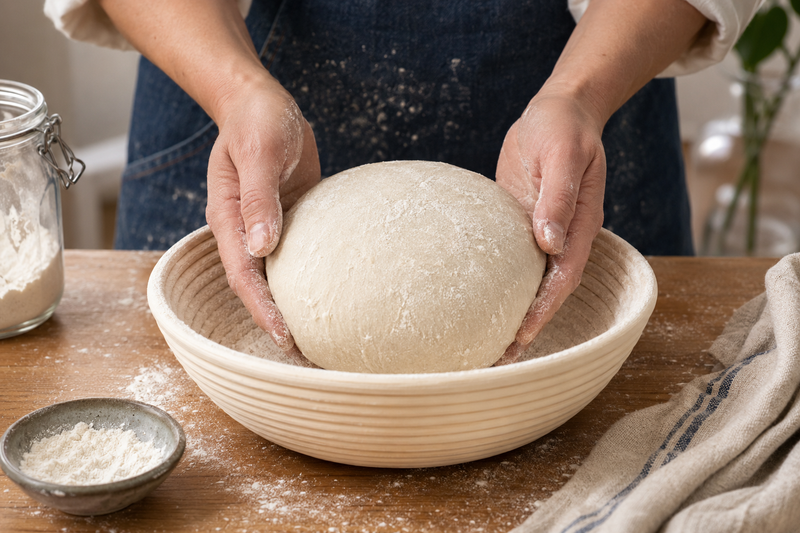
Score and load in one motion. Every second the scored loaf sits at room temperature, the cuts begin to dry and close. Have the Dutch oven hot and the baking paper ready before you pull the dough from the fridge.
Baker's Tip
Score a cold dough — straight from the fridge. The surface is drier and firmer, the cut is cleaner, and the cold dough holds its shape while you work.